Activities
The company has contributed to the capital’s energy supply for more than 100 years. The very first generating unit – the now decommissioned Révész Street heating plant – was built in 1906; the Újpest Power Plant in 1910; and the Kelenföld Power Plant began operations in 1914. All of these plants used coal as fuel for many decades; from the 1960s, coal was replaced by fuel oil, and eventually by natural gas.
In Budapest, district heating supply for industrial purposes started from the Kelenföld Power Plant in 1953, and for residential purposes in 1958. To meet growing residential demand, additional power plants were built in Angyalföld, Kispest, and Kőbánya in the early 1960s. Of these, only the modernized Kispest Power Plant is still in operation today. Their fundamental objective is to produce energy continuously and reliably from a clean energy source, in the most efficient way and with minimal environmental impact.
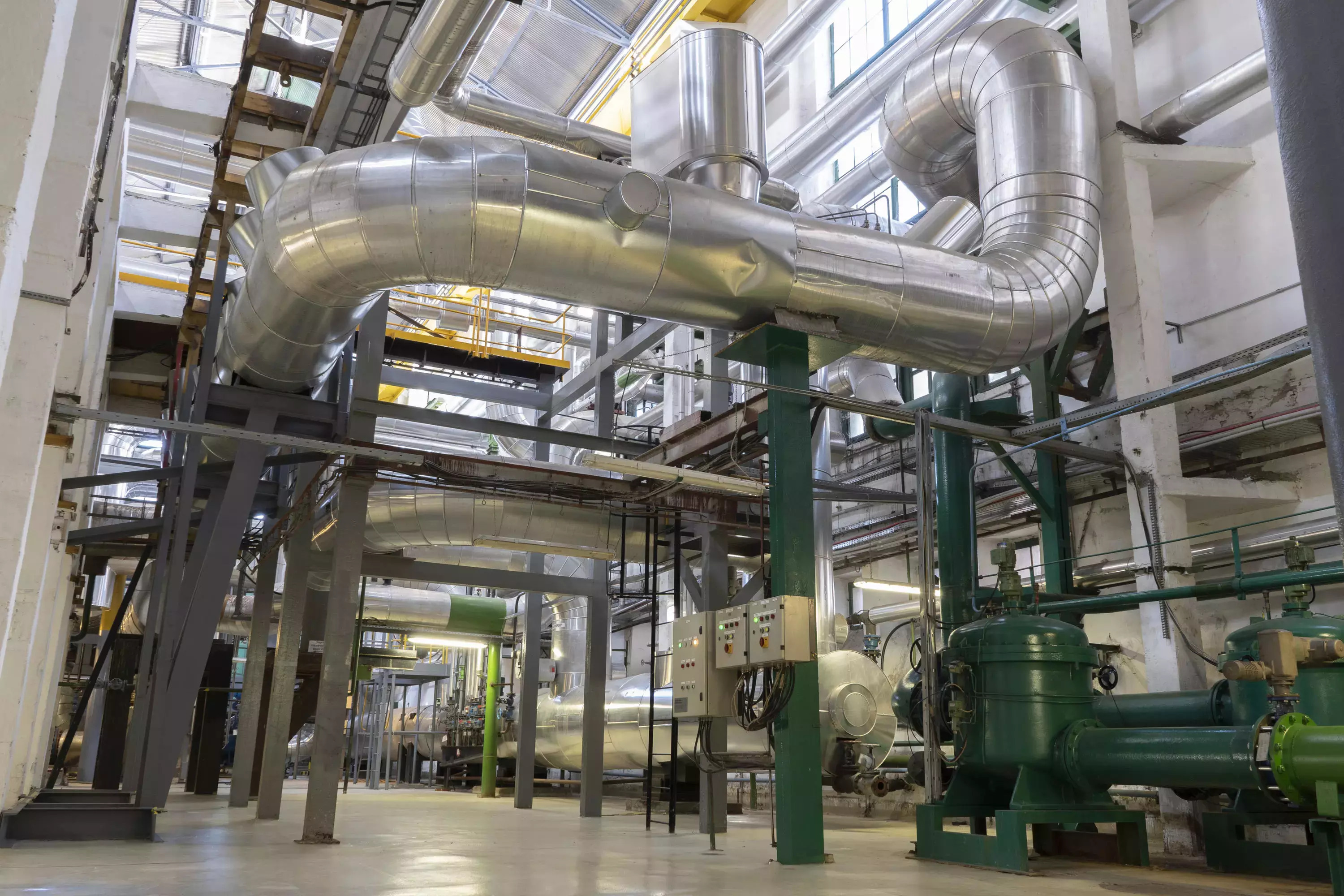
As a result of ongoing developments, both heat and electricity generation are achieved with favourable efficiency and at ever lower cost levels. Thanks to the benefits of combined heat and power generation - primarily due to the decreasing specific fuel consumption - the environmental burden has been gradually reduced. Current pollutant emissions are less than one-fifth of the level prior to the 15-year long power-plant modernization program.
As a result of technological upgrades and improved service quality, district heating is provided without interruption to nearly half a million consumers living in more than 140,000 district-heated apartments, as well as to 4,100 public institutions, increasing user comfort.
Since 2012, Budapesti Erőmű Zrt.’s gas turbines - leveraging their highly flexible controllability across a very wide output range - have been reliably participating in secondary control services for the national electricity system. Since 2018, the Kelenföld Power Plant has also taken part in tertiary control.
Environmental protection

Fuel use
To operate our combustion equipment, we primarily use natural gas, while fuel oil is used as a backup fuel. Natural gas reaches the power plants via pipeline, while oil is stored in tanks. The latter is primarily needed in the event of an interruption in gas supply during emergency situations.
Water use
The water demand required for production is covered with water from the Danube at the Kelenföld Power Plant, and with industrial water at the Kispest and Újpest Power Plants. A significant portion of the liquid used is for cooling our equipment; it does not enter the technological process, but passes through the cooling system with minimal treatment (e.g., filtration). In the case of both Danube water and industrial water use, we strive to recirculate and reuse as large a share as possible.
Heat and electricity generation
Our power plants have a dual purpose: producing domestic hot water and district heating, and generating electricity for the national electricity grid.
We produce heat and electricity in large combustion units using turbines and generators. Combined-cycle cogeneration consists of gas and steam cycles. In the gas turbine, the hot flue gas produced during combustion (gas cycle) - at a high temperature of approx. 560–580 °C and with high energy - generates electricity via a generator. The hot flue gas then enters the heat recovery boiler (steam cycle), where the steam produced is used to generate electricity, industrial steam, and heat for residential customers.
The technology we use is considered the best available.
Air quality protection
Since our combustion equipment primarily operates on natural gas, in terms of air pollutant emissions we mainly consider emissions of nitrogen oxides, carbon monoxide, and carbon dioxide. Emissions of sulfur dioxide, solids (soot, dust), and heavy metals occur only in the case of oil firing; therefore, their quantities are negligible.
We continuously monitor, or periodically measure with an accredited laboratory, emissions from our combustion equipment in accordance with legal requirements. We track and record the data and fulfill our reporting obligations.
Water quality protection
At our plants, we produce the required water quality for use in boilers and in district heating systems by means of ion-exchange demineralization. This process is preceded by lime softening in the case of the Kelenföld and Kispest Power Plants. Wastewater from this process is discharged to the sewer after pH adjustment. Stormwater from fuel-oil systems is cleaned through oil separators. Our wastewater discharges are regularly tested by an accredited laboratory based on our self-monitoring plans.
Soil and groundwater protection
We have carried out a number of remediation projects on the sites of our power plants, all of which are linked to former fuel-oil firing and, naturally, the associated equipment. In parallel with the remediation and the phase-out of fuel-oil firing, we decommissioned not only the reinforced-concrete tanks, but also all related technological components (oil separators, pipelines, pumps, etc.). Of the technical interventions started in the early 2000s, one post-monitoring program is still ongoing; the others have been closed by official decisions.
At all our power plants, we operate groundwater monitoring wells and have groundwater tested at regular intervals by an accredited laboratory.
Noise protection
Noise protection issues received special emphasis during power-plant developments, as protected buildings and residential buildings are located very close to the plants. Therefore, we placed various noise sources inside buildings, and where this was not possible, we used noise abatement installations. Thanks to our efforts, we have been able to reduce the plants’ noise emissions below the limit values.
Waste management
During our activities, hazardous, industrial, and municipal waste is generated; we collect it selectively on site. At each of our plants we operate a hazardous waste collection point, from which transport is carried out by a licensed contractor. Larger quantities of hazardous waste are primarily linked to oil firing and to the maintenance and cleaning of its technological equipment (e.g., oily water, oil sludge).
Sustainable development
At our power plants we produce district heating for approximately 140,000 apartments and also generate electricity for the national system. Since this must be done in an urban environment, the technology used is combined-cycle cogeneration, considered the best available technology, with an efficiency of approximately 84%. To operate our combustion equipment we use fossil fuel, almost 100% natural gas. The applied technology and the cleanest fossil fuel ensure that our activities cause the lowest possible environmental impact in the capital.
Nature conservation
The power plants are surrounded by housing estates and detached family homes with garden, interspersed with industrial areas. Part of the power-plant area is landscaped, with ornamental trees (e.g., silver fir, western hackberry, etc.) and middle-aged planted poplars. The power plants are classified as industrial areas; they have no nature conservation or landscape protection functions.
Survey of wildlife at the Kispest Power Plant
The production equipment of the Kispest Power Plant is located in the middle of a very large site, so the site perimeter is wooded, shrubby, and park-like. Therefore, in 2010 we commissioned a survey with staff from the Hungarian Ornithological and Nature Conservation Society to take stock of all plant and animal species found on the power-plant premises. The survey produced surprising results, showing that even in such a heavily industrialized area there are natural assets in significant numbers. Based on the results, we focused on bird protection, and through employee cooperation we installed numerous nesting boxes and bird feeders on the premises. Thanks to successful bird protection activities, the Kispest Power Plant received the “Bird-Friendly Workplace” title from the Hungarian Ornithological and Nature Conservation Society.

Anti-corruption
Budapesti Erőmű Zrt. operates an Anti-Bribery Management System (ABMS) in accordance with the MSZ ISO 37001:2019 standard.
You can read about the Veolia Group’s compliance activities at the following link: https://www.veolia.hu/en/about-us/compliance
Our company has introduced procedures that encourage and enable the reporting of corruption committed or suspected.
Reports can be submitted by post (address: 2020 Budaörs, Szabadság út 301.; recommended marking: “Report, Strictly Confidential!” “For the National Compliance Officer”), or via the email address [email protected].
We investigate all reported corruption or suspicions. During the investigation, cooperation is required from everyone. Depending on the outcome – which we treat confidentially – we take the necessary measures in every case.
Downloadable documents
Management system
Central procurement, supplier offers, tenders
Energy auditor reports